Our virtual lunar city
and chat room
Visitors are welcome!
|
.
|
Current Projects
Current Projects
updated
02/18/2008
Lunar Analog Research
Activities
To determine whether or not the Moon
Society should undertake Lunar Analog Research Activities, we
proposed to rent the Mars Society's Mars Desert Research Station
(MDRS) for the purpose of conducting lunar outpost simulation
exercises. Moon Society crews of six persons each would undertake
a variety or research projects over two week periods at this
facility outside of Hanksville, Utah. The experiences and lessons
learned by our crews will allow us to better design and outfit our
own research station as part of Project Leto. This project will be
undertaken in collaboration with the Mars Society.
In order to become familiar with the Mars
Society's Utah facility, Society President Peter Kokh joined MDRS
crew
#34 in February, 2005. This
experience was essential to serve as a reality check for what
kinds of projects a Moon Society Crew could fruitfully undertake
at MDRS.
The following field season, we rented MDRS
for two weeks, February 26 - March 12, 2006, and conducted our
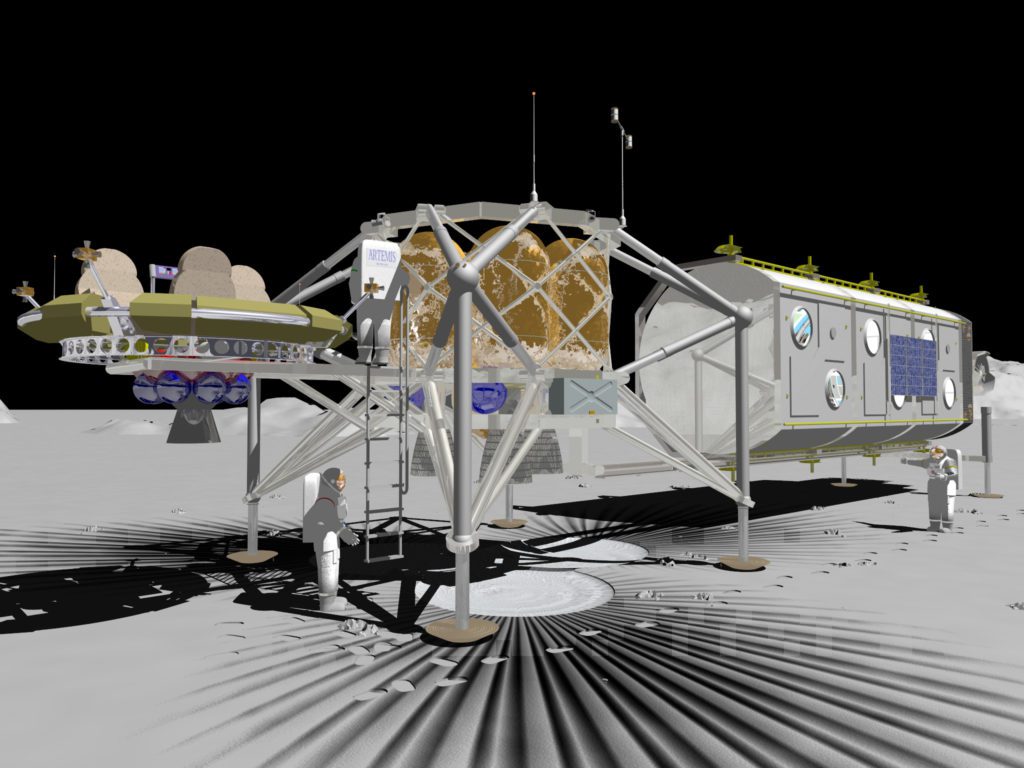
first "Artemis
Moonbase Simulation" exercise
there as MDRS Crew
#45.
Latest
Updates and News Our
Mission is a "Success"
Our
PowerPoint Slide Show:
Download this 11.7 mb production graciously created for us by one
of our mission volunteer CapComs, Gerry Williams of
Mars
Society San Diego.
Or Download the
pdf
file version of this
slide show.
.
Read
our 8/13/2006 Blog post:
Five months after our 1st Moonbase Exercise
Read
our 10/01/2006 Blog Post:
Candidate Analog Sites for a Lunar Research
Station
We have now clearly defined the logical
differences
between a lunar analog research program and a Mars analog research
program, and have set out to
"define" and "design" what a Moon Society Lunar Analog Program
might be like.
Check out our PowerPoint
Slide show (pdf
version) which continues to be
a "work in progress." This effort will continue until we have a
well-thought out and fully costed multiphase program to show to
potential financial sponsors.
top
Artemis
Data Book [ADB] Improvement
Project
In the summer of 2006, a student
intern group operating under Dr. Peter J. Schubert, a Moon Society
Board member, endeavored to fill some of the gaps in the Artemis
Data Book. The project was conducted at the Packer Engineering
offices in Naperville, Illinois.
Check out their
work - some articles will need
revision before posting to the Artemis Data Book, or to our newly
launched MoonWiki Lunarpedia
top
Lunarpedia
- Our
Moon-Wiki
Project
October 5, 2006: This is an
initiative that a circle of members have discussed during much of
2006 before deciding in September to make it happen. We had our
grand unveiling in January 2007.
The Lunarpedia is an open-source,
wiki-type replacement for the proprietary Artemis Data Book. We
know many of our older members who joined us in the Artemis
Society years, 1994-2000, have missed working on the Artemis
Reference Mission and the Artemis Data Book. We are
betting that without proprietary limitations, www.Lunarpedia.org
will be much more successful.
The object is to create a "buffet" of
options that will allow enterprises with funding to pick and
choose whatever suits their own mission plan. In other words,
we care more that there is a first for-profit lunar outpost
than we care who builds it.
top
The
University of Luna Project
First conceived in early 1991, and
the subject of a poorly attended workshop at the 1998
International Space Development Conference in Milwaukee, this
project has been the object of considerable development since June
2006, and made its grand debut at the 2007 ISDC in Dallas,
TX.
The work of Society President, Peter Kokh
and Director of Project Development David A. Dunlop, the
University of Luna Project will seek to engage students and
enterprise in advancing the readiness state of the many
technologies that will be needed for human presence on the Moon to
become truly permanent and self-supporting as part of an expanded
Earth-Moon economy. The "ULP" will be a Moon Society "spin-off" in
that it will have its own website, officers, and Board of
Directors.
However, the effect of the University of
Luna Project will be to keep al other Moon Society projects on
focus and on target, for maximum effectiveness, advancing the day
when human civilians will be on the Moon to stay.
top
The
Moon Miners' Manifesto Archive
Project
The editor of the society's
newsletter, now past its 20th anniversary of continuous
publication, ten issues a year, has embarked on an ambitious
project to archive the non-time sensitive material from past
issues, one year at a time, up to three years shy of the current
year. As of January 2008, the first eighteen volumes of the
MMM
Classics are online, as freely
accessible pdf files.
top
Videotaping Project at ISDC
2007
At the 2007 International Space
Development Conference (ISDC) held in Dallas, Texas, we began an
ambitious project to videotape interviews with various people
connected to the Back to the Moon movement. The brainchild of
Director James Gholston, videotaping was done by member Chip
Proser and son Noah, with David Dunlop and James Gholston asking
initial and follow-up questions. Over seven hours of video was
shot, all of it against a green screen so that we could add
appropriate backgrounds later.
Thirty-some
videos are now online, created
from this material that promote the Moon Society, its vision and
its goals! You need to have Flash player downloaded to your
computer to see them. One of them is also on our MySpace.com
website. We are greatly indebted to Moon Society member and
Advisor Chip Proser for all his work and effort in creating these
outstanding promotional Moon
Colony Videos, and to Board
member James Gholston for having the vision to suggest we
undertake this effort.
top
Railroading on the Moon
& Mars Design Project
In 1993, Moon Miners' Manifesto
sponsored a brainstorming project on the possibilities for
Railroads on the Moon. Eight persons from around the country had
input. The paper was published on the Lunar Reclamation Society
(publishers of MMM for the Moon Society and other clients)
website. Read Railroading
on the Moon.
Now, fifteen years later, it is time to
revisit this exciting possibility. As railroads are a surface
transportation option for Mars as well, we turned to a
Mars-focused organization that had already signaled its interest
in collaborating with the Moon Society, MarsDrive.
They immediately accepted our proposal and within two days we had
put up a jointly sponsored Google
Group: Railroading on Moon & Mars.
We welcome widespread involvement.
top
Space Solar Power Beaming
Demonstration
We have undertaken to
design
and build a table top demonstration of a solar power satellite
beaming microwave power to a rectenna
as part of our promotion of the National Space Security Office
report, released October 10, 2007, that concluded that erecting a
Solar Power Satellite network in GEO could provide the only
pathway to true energy independence for the United States, further
suggesting that the only affordable way to do that would be to use
construction materials made on the Moon, or made in space from
lunar materials. Together with the National Space Society we
joined a thirteen
member alliance to promote this goal.
This is our first "hands on" "bending metal" project. We
hope to have it ready to demonstrate at ISDC 2008 in Washington DC
in late May. We are fortunate to have the critical expertise
needed within the society. You can track
our progress here.
top
Collaborations
with other organizations can be an
effective strategy and tool in producing successful
projects.
top
Project
Guidelines for Success
top.
Completed, Deferred, and
Discontinued Projects
The Artemis
Project
The flagship project of the Artemis
Society was The Artemis Project, an effort
ongoing since 1994 to design, fund, and deploy the first private
lunar base for commerce and tourism. Here is a brief
overview of The Artemis Project.
ASI members were enthusiastic about it and helped develop the
Artemis Project Reference Mission.
When the membership was transitioned to
the new Moon Society, after its founding in July, 2000, there was
an effort to continue focus on The Artemis
Project, as a "Flagship Project." However, the
proprietary character of the Project made this impractical, and
all further progress came to a halt as one ASI team after another
disbanded in discouragement.
The Moon Society and Artemis
Society International remain
affiliated (but separate) organizations. The Artemis Society
International website has unfortunately become fossilized with no
one to maintain it. In January, 2007, members of The Moon Society
launched an open-source substitute for the Artemis Project
Reference Mission, an online Wiki-type encyclopedia of all
things "Moon, past, present, and future. This project is the
Lunarpedia at www.Lunarpedia.org
- see Lunarpedia entry above.
section
top - page
top
Project LETO
Project
LETO
[L.E.T.O. = Lunar Exploration & Tourist
Organization]
was to have been the first major
long term project for the Moon Society. This is a strategic plan
to build a full-scale simulation of an initial lunar exploration
base. It would be marketed for outreach purposes, analog research,
and as a tourist destination.
A "full-scale simulation of an initial
lunar exploration base" is not necessarily the same as a Lunar
Analog Research Station. In the latter, to avoid costs irrelevant
to the research program, it is not necessary to exactly model a
first lunar exploration base, except where needed to support the
research program. If money were no object, we could do both.
Instead, we must pick our battles, choose which aspects and
features to simulate, and which to ignore as irrelevant to the
research.
As a proposal to combine a tourist center
with research station activities, Project LETO presupposes that
these two different types of activity are compatible. Every
indication is that tourist activity would shatter the
concentration of research station crews, there being ample
anecdotal evidence from the Mars Society's experiences at the Mars
Desert Research Station in Utah. But a mockup station at the
visitors center, where the pubic can watch activities at a remote
research station via live web cams, might be the better solution.
Such a solution would make it unnecessary to make compromises
either as to the location of the tourist center or as to the
geologically appropriate location of the research station.
Further, under this plan, the research station could have web cam
access to a multiplicity of research stations scattered around the
globe.
The Project LETO plan also begs the
question of which should come first: a tourist center to bring in
money and new members, or a research station. There can be no
question about the paramount importance of both. As to which
should come first, perhaps the best answer is both, with tourist
center and research station both being built in phases, growing in
parallel, however closely or remotely collocated. Our priority is
to define and design exactly the kind of Analog Research Station
that we need to pursue our goals of research, development, and
demonstration, find an appropriate site, with hard choices being
made with due consideration to land cost and logistics of
construction and support. Then we can take up the idea of visitors
centers, and yes, why not more than one. If the connection is made
via web-cams, an inexpensive visitors mockup moonbase could be
replicated in several tourist traffic nodes or wherever
donor-sponsors wanted to place them.
Because money is an object, and Project
Leto as conceived would cost an order of magnitude larger
capitalization, our focus is on continuing to refine our design
for a phase by phase realization of an initial lunar Analog
station. See a presentiton on the current state of this
work-in-progress brainstorming effort. PDF
file Slide Show- PowerPoint
Slide Show
section
top - page
top
Moon Flag Contest:
The first project announced by the
Moon Society was a design contest for a lunar flag. This contest
was closed after several months, as only one entry had been
submitted.
section
top - page
top
The
Moon-Mars Homestead Project
This was to have been a
collaboration with a new initiative begun by members of the Mars
Society in the summer of 2004 to "identify and demonstrate the
technologies" that, using local resources, would allow us to move
swiftly from an initial outpost to permanent settlement. A
significant number of the technologies needed on Mars will be of
relevance to establishing settlements on the Moon as well. There
will, of course, be some technologies needed on the Moon that will
not apply to Mars, and vice versa.
However, Moon Society members had access
only to the high-noise level general discussion list, and not to
the inner circle of brainstorming activity, which would have been
necessary if we were to learn anything from this activity. At some
time in the future we could embark on our own parallel project. As
the University of Luna Project (above) makes progress, the
Research & Development that it promotes and supports would lay
the foundations for such an endeavor.
section
top - page
top
Copyright © 2000-2008 The Moon Society. All Rights Reserved.
Questions and comments to: webmaster@moonsociety.org
Submit a Request to update
this page
|