Over the weekend of July 22–23, 2000, at Caesars Palace in Las Vegas, members of the Artemis Society International and the wider spacefaring community gathered to charter a new organization devoted entirely to the human settlement of the Moon. Across two days, the Moon Society was formally organized.
What was decided
Gregory R. Bennett, founder of the Artemis Project, a former NASA engineer, and then Vice President of Bigelow Aerospace, was elected the Society’s first President, alongside a full slate of officers and a five-member Board of Directors. A Board of Advisors was created and the Society’s official bylaws were approved.
Those bylaws chartered the Moon Society as a 501(c)(3) non-profit scientific and educational foundation, formed “to promote all aspects of the study, exploration, settlement, and development of the Earth’s Moon, Luna,” and to advance space education. The Society was established with the assistance of the National Space Society, the Space Frontier Foundation, the Space Studies Institute, the Mars Society, and the Planetary Society.
Project Leto, a program to build a simulated lunar base, was approved as the Society’s first major project, with candidate sites in California, Nevada, and Hawaii. And every member and chapter of the Artemis Society International became, that weekend, a member and chapter of the new Moon Society.
The program
The two-day program, assembled by Peter Kokh, editor of the Moon Miners’ Manifesto, opened with organizational basics (vision and mission statements, incorporation, the bylaws report, and officer elections) and moved through theme presentations on lunar passenger transportation and settlement, the transition of the Artemis Project to its new role, chapter workshops, and poster sessions.
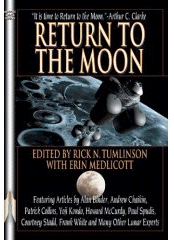
The founding weekend immediately followed the Lunar Development Conference (Return to the Moon II), a formal papers conference held July 20–21 at the same venue and focused on the development of lunar industries, co-sponsored by the Space Frontier Foundation, the Space Studies Institute, and the National Space Society.